Middle Tennessee has a mold problem that most homeowners only discover the hard way — during a home sale inspection, after a health symptom they cannot explain, or when they open a closet and find what looks like a black stain growing up the wall. Murfreesboro and the surrounding Rutherford County communities sit in one of the most humidity-intensive climate zones in the continental United States, and that climate has direct, measurable consequences for basement and crawl space mold growth that most national guides and even some local restoration companies still underestimate.
This guide covers why Murfreesboro homes are particularly susceptible to mold, where mold hides in Middle Tennessee construction types, how to identify it, what the remediation process actually involves, and what it costs.
Middle Tennessee’s Humidity: The Numbers Behind the Risk
Mold remediation in murfreesboro tn needs three things to grow: moisture, an organic food source (wood, drywall, insulation), and a temperature above 40°F. All three conditions exist year-round in Murfreesboro. But the moisture piece — specifically relative humidity — is where Middle Tennessee’s climate becomes a major factor.
Murfreesboro’s average relative humidity by season:
- Summer (June–September): 70–80%, peaking in the morning hours
- Fall (October–November): 60–75%
- Winter (December–February): 65–78%
- Spring (March–May): 65–80% during storm systems
For comparison, the relative humidity level at which mold growth becomes possible on organic materials is generally cited at 60% — a threshold Murfreesboro exceeds for most of the year. When the national mold guideline says mold can grow “within 48 hours of a water intrusion event,” that timeline assumes moderate humidity conditions. In Murfreesboro’s summer environment — with outdoor humidity already at 75% when a pipe bursts — active mold germination can begin within 24 hours, and in the confined space of a vented crawl space, often faster.
Why Murfreesboro Crawl Spaces Are Especially Vulnerable
The most common construction type across Rutherford County’s residential building stock — from the mid-century neighborhoods near downtown to the post-2000 subdivisions in Blackman and Smyrna — is the vented crawl space. Homes are built on a raised foundation with a crawl space beneath the first floor, and that crawl space is typically ventilated to outside air with foundation vents.
The theory behind vented crawl spaces — that outside air will dry the space and prevent moisture buildup — was good building science in climates with low ambient humidity. In Middle Tennessee, it fails badly.
What actually happens in a Murfreesboro vented crawl space:
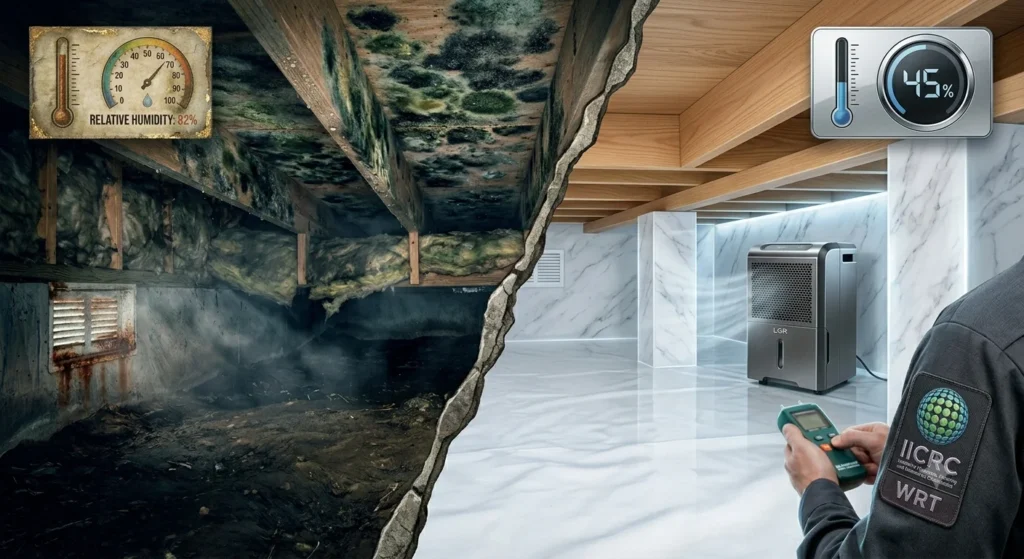
In summer, outside air at 78% relative humidity enters through foundation vents. That humid air contacts the cooler surfaces inside the crawl space — earth floor, concrete piers, floor joists — and the relative humidity at those surfaces spikes even higher as the air cools. Water vapor condenses on wooden structural members. The wood absorbs moisture. The moisture content of floor joists, subfloor sheathing, and girders rises into the range where mold growth is not just possible but nearly inevitable without active moisture control.
This process happens continuously, every summer, in tens of thousands of Rutherford County homes. The crawl space never floods. There is no burst pipe. There is no visible water event. The mold grows from ambient humidity alone.
The result:
- Dark staining on floor joists (early mold colonization)
- White efflorescence on concrete piers
- Musty odor rising into the first floor living space
- Elevated indoor humidity throughout the home
- Higher air conditioning load as the system tries to dehumidify humid air rising from below
Where Mold Hides in Murfreesboro Homes
Based on our remediation work across Rutherford County, these are the most common locations where mold develops in Murfreesboro homes, roughly ordered by frequency:
1. Crawl space floor joists and subfloor sheathing The most common single location. Vented crawl spaces allow summer humidity to condense on structural wood. By the time it is visible to a casual inspection, colonization has often been ongoing for 1–3 years.
2. Under kitchen and bathroom sinks Slow drips from supply lines or drain connections create sustained moisture on cabinet interiors. The inside of a sink cabinet is dark, poorly ventilated, and in direct contact with damp wood — ideal mold conditions. Many Murfreesboro homeowners discover this only when the cabinet floor softens or stains appear.
3. Behind bathroom tile and walls Shower and tub surrounds with failing grout or caulk allow water to penetrate behind tile and into the wall assembly. Drywall behind tile will begin growing mold within weeks of regular moisture exposure. The damage is typically not visible until tile grout darkens or an odor develops.
4. HVAC air handler and ductwork Murfreesboro’s humidity means air conditioners run nearly constantly from May through September. Air handler units accumulate moisture during normal operation. A dirty evaporator coil, a clogged condensate drain, or poor ductwork insulation creates conditions for mold growth inside the air distribution system — which then circulates spores throughout the entire home.
5. Basement walls and floor slab edges Homes with finished or unfinished basements — particularly in Rutherford County neighborhoods with clay soil that sheds water toward foundations — develop mold along the wall-floor junction where hydrostatic moisture migrates through concrete. The mold feeds on the paper facing of drywall installed against the foundation wall.
6. Behind kitchen and bathroom drywall after appliance failures After a washing machine overflow, dishwasher leak, or water heater failure that is cleaned up with consumer-grade equipment, moisture remains trapped behind drywall and under flooring. In Murfreesboro’s humidity, this residual moisture becomes active mold within days.
La Vergne TN: A Special Case for Mold Risk
La Vergne, situated on the eastern shore of Percy Priest Lake, faces a compounding mold risk factor that the broader Rutherford County area does not share: lake effect humidity. The large water surface of Percy Priest Lake drives ambient humidity in La Vergne consistently higher than inland areas of the county. Homes in water damage La Vergne’s older lakefront neighborhoods and commercial corridor near Waldron Road experience crawl space mold at elevated rates compared to inland Murfreesboro.
Rutherford Water Restoration serves La Vergne 24/7 with the same IICRC S520-compliant mold remediation process as our Murfreesboro service area. If you are in La Vergne and have noticed musty odors or visible staining, contact us immediately.
How to Identify Mold in you Murfreesboro Home
Not all mold is visible, and not all discoloration is mold. Here is how to evaluate what you are seeing (and smelling):
Musty odor in specific areas: A persistent earthy, musty smell in one room or when the HVAC runs is often the first sign of mold before any visual evidence. The odor from a crawl space will typically be strongest at floor level in the rooms directly above the crawl space.
Dark staining on walls or ceilings: Not all staining is mold — mineral efflorescence, tannin staining from wood, and water marks can look similar. Mold staining is typically fuzzy or powdery in texture when inspected closely, and often has a greenish, black, or gray tint.
The bleach test (limited): Applying diluted bleach to a small suspect area — if the discoloration fades, it may be mold; if it does not, it is likely a mineral stain. However, this test is inconclusive and does not substitute for professional inspection. Bleach does not address sub-surface mold in porous materials.
Physical symptoms: If household members experience worsening allergy symptoms, unexplained headaches, or respiratory irritation that improves when they leave the home, mold exposure may be a contributing factor. This is particularly relevant in homes with crawl space mold, as HVAC systems actively draw conditioned air from below the floor.
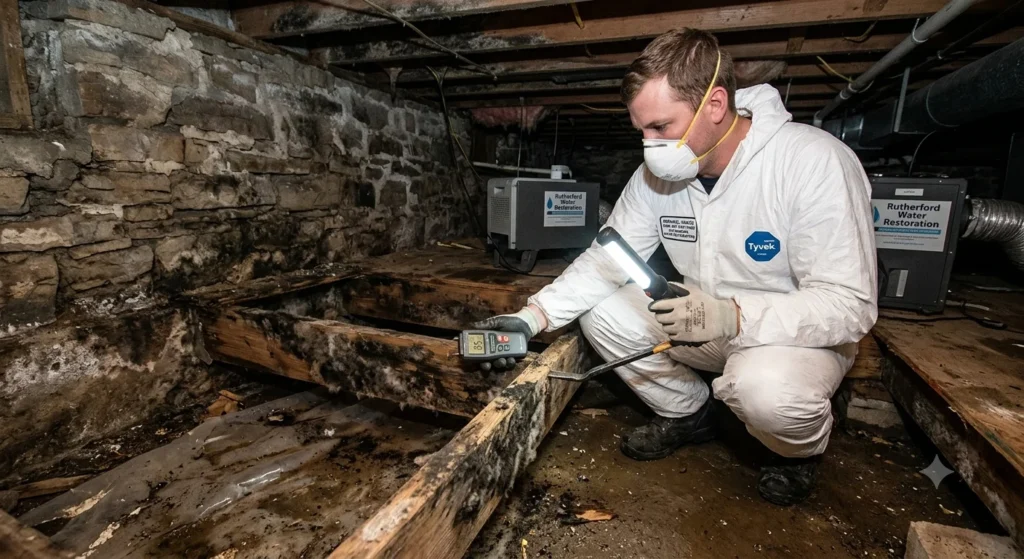
Professional inspection: The only reliable way to determine the presence and extent of mold in your Murfreesboro home is a professional inspection using moisture meters, thermal imaging cameras, and air quality sampling. Visual inspection alone misses the majority of mold in typical residential water damage situations.
The IICRC S520 Mold Remediation Process
All mold remediation performed by Rutherford Water Restoration follows the IICRC S520 Standard for Professional Mold Remediation. Here is what that process involves:
Step 1 — Moisture source identification Mold cannot be permanently eliminated without identifying and correcting the moisture source. Remediation without addressing the source guarantees recurrence. We use thermal imaging and calibrated moisture meters to locate every moisture pathway before any physical remediation begins.
Step 2 — Containment HEPA-rated plastic containment barriers are erected around the affected area to prevent spores from spreading to clean areas during removal. Negative air pressure systems maintain airflow from clean to contaminated areas. The work zone is completely sealed.
Step 3 — Air filtration HEPA air scrubbers run continuously during remediation, capturing mold spores at 0.3 microns — smaller than is visible to the naked eye. This protects both occupants and technicians during the removal process.
Step 4 — Physical removal Contaminated materials that cannot be cleaned — drywall, insulation, porous wood with deep colonization — are removed, bagged in sealed plastic, and disposed of per Tennessee environmental regulations. Non-porous surfaces are cleaned with HEPA vacuums and antimicrobial agents.
Step 5 — Antimicrobial treatment All affected structural surfaces receive antimicrobial treatment specifically formulated for porous building materials. This is not bleach — it is an EPA-registered antimicrobial designed to penetrate wood and masonry surfaces and inhibit regrowth.
Step 6 — Clearance testing Post-remediation air quality testing confirms that spore counts in the treated area have returned to or below outdoor ambient levels. This objective data is provided to the homeowner and, if applicable, to their insurance adjuster.
Step 7 — Moisture control installation Depending on the moisture source, we recommend or coordinate crawl space encapsulation, foundation waterproofing, dehumidifier installation, or HVAC remediation to prevent recurrence.
Crawl Space Encapsulation: The Long-Term Solution for Rutherford County
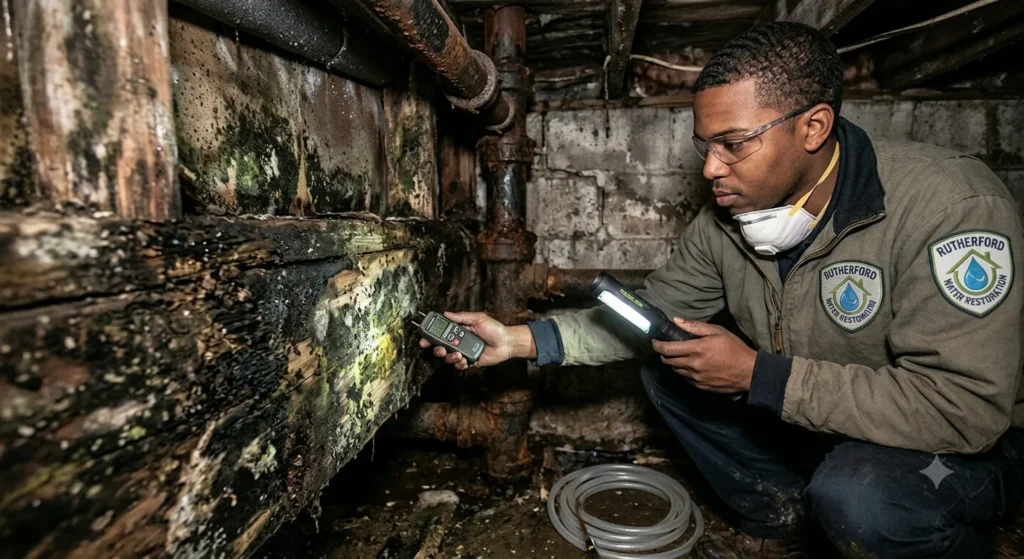
For Murfreesboro homes with vented crawl spaces — which is the majority of the county’s residential building stock — the long-term solution to recurring crawl space mold is encapsulation.
Crawl space encapsulation involves:
- Sealing the earth floor with a heavy-gauge vapor barrier
- Sealing all foundation vents
- Installing a dedicated crawl space dehumidifier
- Insulating the foundation walls rather than the floor joists
This converts the vented crawl space from a humidity sponge to a semi-conditioned space. In Middle Tennessee’s climate, encapsulation typically reduces crawl space humidity from 70–90% to 50–55% year-round — below the threshold where mold growth is sustained on structural wood.
The upfront cost of crawl space encapsulation in a Murfreesboro home ranges from $3,000–$8,000 depending on size and condition. Homeowners typically see HVAC energy savings of 15–20% annually, elimination of recurring mold treatments, and improved indoor air quality throughout the home.
How Much Does Expensive Mold Remediation in Murfreesboro tn ?
Costs vary significantly based on the scope and location of contamination:
| Scenario | Estimated Cost Range |
| Single-room surface mold (bathroom, under-sink) | $500–$1,500 |
| Crawl space mold remediation (typical Murfreesboro home) | $2,500–$6,000 |
| Mold after water damage (one room, drywall removal) | $1,500–$4,000 |
| Whole-home HVAC mold (ductwork + air handler) | $2,000–$5,000 |
| Severe mold (multiple rooms, structural materials) | $8,000–$25,000+ |
When mold remediation results directly from a covered water damage event — a burst pipe, appliance failure, or storm roof damage — your Tennessee homeowners insurance typically covers the remediation cost. Mold from chronic moisture problems without a sudden event is usually not covered. Our documentation supports legitimate insurance claims from day one.
Frequently Asked Questions
How quickly does mold grow in Murfreesboro after water damage?
In Middle Tennessee’s 70–80% summer humidity, mold germination can begin within 24 hours of a water intrusion event. This is faster than the 48-hour window cited in national guidelines. Professional drying and antimicrobial treatment must begin the same day.
Is black mold more dangerous than other mold?
All mold species can be problematic for air quality and structural integrity. Stachybotrys chartarum (commonly called “black mold”) is associated with more severe health effects and requires specific handling protocols. However, visual identification of mold species is not reliable — laboratory air sampling or surface testing is necessary to identify specific species. All mold remediation by our team follows IICRC S520 protocols regardless of species.
How do I know if my Murfreesboro home has mold in the crawl space?
Signs include a persistent musty odor at floor level, allergy or respiratory symptoms that worsen at home, or higher-than-normal cooling costs. The only reliable assessment is a professional crawl space inspection with moisture measurement. We offer free assessments for Murfreesboro and Rutherford County homes.
Will mold come back after remediation?
Properly performed remediation to IICRC S520 standards, combined with correction of the moisture source, prevents recurrence. Mold that returns after professional remediation indicates that either the moisture source was not fully corrected or the remediation was incomplete. This is why moisture source correction is Step 1 in our process.
Schedule a Mold Assessment for Your Murfreesboro Home
If you have noticed musty odors, visible staining, or allergy symptoms in your Rutherford County home, do not wait. Mold grows faster in Middle Tennessee’s climate than anywhere else in the upper South, and early professional assessment is significantly less expensive than late-stage remediation.
Call Rutherford Water Restoration at (615) 703-6099 IICRC-certified. 45-minute response. Serving Murfreesboro, La Vergne, Smyrna, and all of Rutherford County.