A toilet overflow, a backed-up floor drain, a sewage smell rising from your basement — these events feel like water damage in Murfreesboro they are categorically different in three critical ways: the health hazard is far more serious, the insurance coverage is handled differently, and the cleanup process requires biohazard protocols that standard water damage restoration does not. This guide explains what Murfreesboro and Rutherford County homeowners need to know about sewage backup specifically — not just water damage generally — so you can respond correctly if it happens to you.
The IICRC Water Category System: Why It Matters
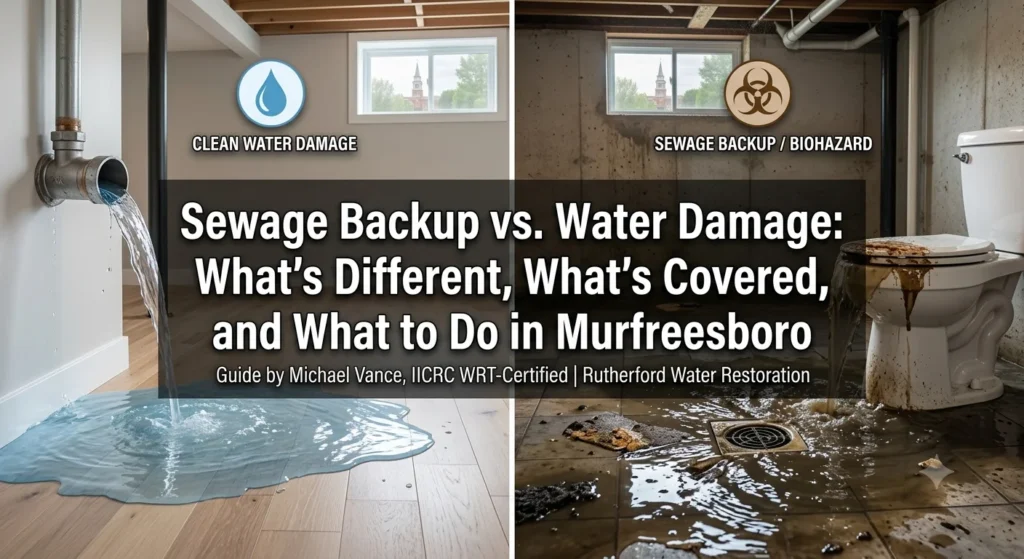
The restoration industry — including Rutherford Water Restoration — follows the IICRC S500 Standard classification system for water damage. This system defines three categories of water based on contamination level, and each category requires a different response protocol.
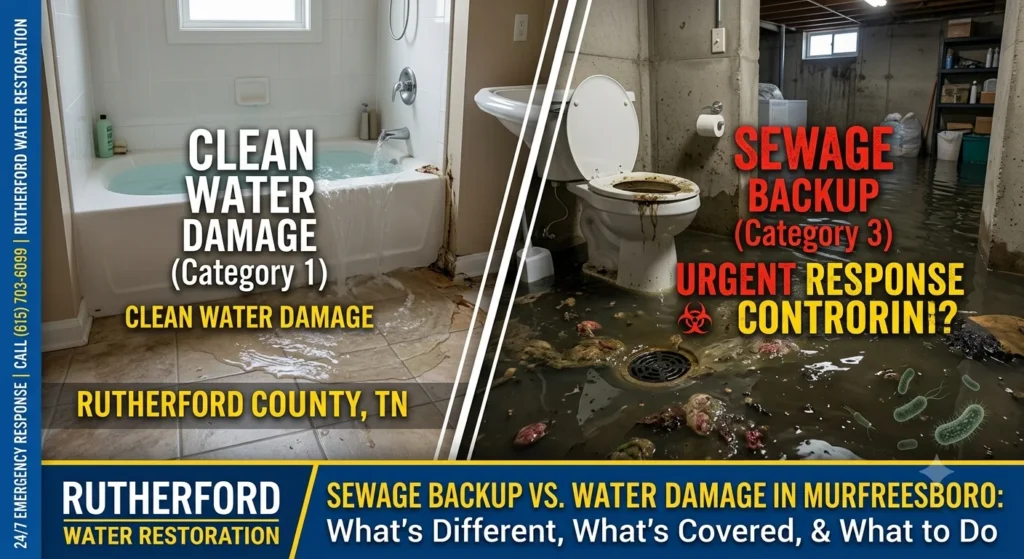
Category 1 — Clean Water Water originating from a sanitary source with no substantial risk to health. Examples include a burst supply line, a water heater rupture (first few minutes), or a failed appliance water inlet hose. Category 1 water can become Category 2 if it contacts building materials and begins to deteriorate.
Category 2 — Gray Water Water containing significant contamination and with potential to cause discomfort or illness if consumed or contacted directly. Examples include washing machine discharge (wash cycle, not rinse), dishwasher overflow, toilet bowl overflow with urine only (no feces), and aquarium water. Gray water requires protective equipment during cleanup and antimicrobial treatment of affected materials.
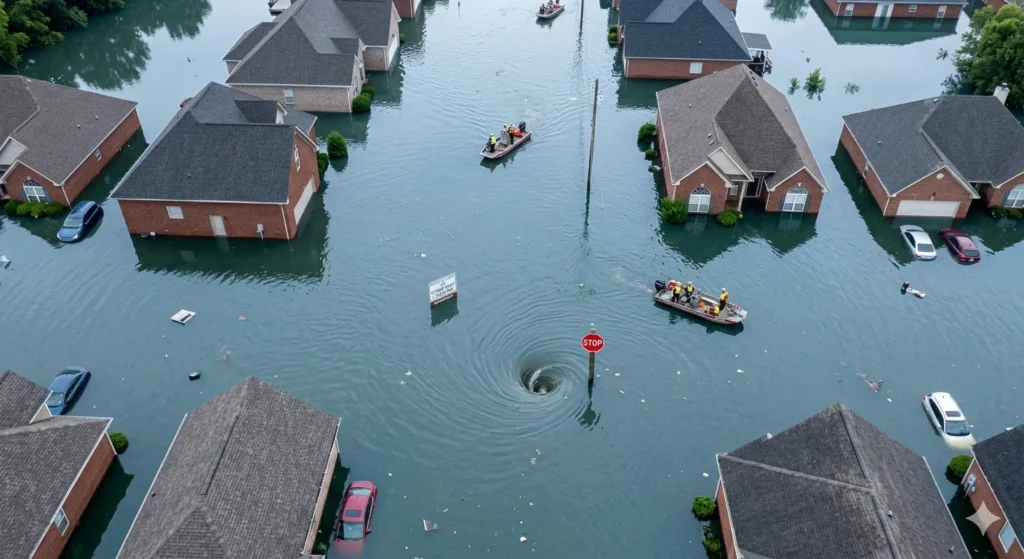
Category 3 — Black Water Grossly contaminated water containing pathogenic agents. This includes all sewage backup, regardless of whether it looks brown or clear. Sewage water contains fecal bacteria including E. coli, Salmonella, hepatitis A virus, and parasites. Category 3 also includes floodwater that has contacted the exterior ground — including Stones River flooding, surface runoff, and water that has entered through foundation drains.
Sewage backup is always Category 3. This is true whether it backs up through a floor drain, a toilet, a tub drain, or a basement sump pit. The entire affected area — all flooring, drywall, insulation, and contents that had contact — must be treated with full biohazard protocols.
Why Sewage Backup Is More Dangerous Than a Burst Pipe
Most Murfreesboro homeowners understand that a burst pipe is urgent because of structural damage and mold risk. Sewage backup is urgent for all of those reasons plus direct health hazard. Here is what Category 3 water contains:
Bacterial pathogens: Sewage reliably contains Escherichia coli (E. coli), Salmonella, Shigella, and other enteric bacteria that cause severe gastrointestinal illness. These bacteria remain viable on wet surfaces and in carpet fibers for days after visible water is removed.
Viral pathogens: Hepatitis A virus is transmitted through fecal-oral contact and survives in sewage. Norovirus, the most common cause of acute gastroenteritis in the U.S., is present in sewage and is highly contagious even at tiny infectious doses.
Parasites: Cryptosporidium and Giardia are sewage-present parasites that can cause severe gastrointestinal illness in children and immunocompromised individuals.
Chemical contaminants: Municipal sewer systems carry not just human waste but cleaning chemicals, pharmaceuticals, and industrial contaminants. These can off-gas from contaminated building materials and create respiratory hazard.
The porous material problem: Carpet, drywall, wood flooring, and concrete block are porous — they absorb and retain sewage contamination even after the water is removed. Simply drying these materials is not sufficient for Category 3 contamination. Porous materials in the affected zone must be removed and disposed of.
This is why the response to a sewage backup in your Murfreesboro home is not “dry it out with fans” — it is a biohazard remediation event that requires personal protective equipment, physical removal of contaminated porous materials, antimicrobial treatment of all remaining surfaces, and air quality verification.
Common Causes of Sewage Backup in Rutherford County Homes
Municipal sewer system overload: During heavy rainfall events — particularly in Murfreesboro’s December-through-April storm season — the municipal combined sewer and stormwater system can exceed capacity. When this happens, sewage flows backward through the least resistant path: into homes through floor drains, basement sinks, and sump pits.
Root infiltration of sewer laterals: The sewer lateral is the underground pipe connecting your home to the municipal sewer main. Tree roots — a common feature of Murfreesboro’s established neighborhoods — grow into sewer lateral joints over decades and create obstructions. When flushing causes a backup, root infiltration is a common cause in older residential areas near downtown Murfreesboro and established neighborhoods.
Grease and debris accumulation: Kitchen drain grease, flushed wipes (even “flushable” varieties), and other debris accumulate in sewer laterals over years and eventually cause blockages. Homes that have not had their sewer lateral inspected in five or more years may have partial blockages developing.
Structural sewer lateral failure: In Murfreesboro’s older housing stock — particularly homes built before 1980 — sewer laterals may be constructed of clay tile or cast iron that has deteriorated over decades. Cracked, collapsed, or offset pipe sections create both blockage and infiltration points.
Sump pump failure during storms: Many Rutherford County homes use sump pumps to manage groundwater. When a sump pump fails during a storm event — due to power outage, mechanical failure, or overwhelmed capacity — the pit can overflow. If the sump pit is connected to the sanitary sewer system (as some older installations are), this overflow can introduce contamination.
What Insurance Covers: Sewage Backup vs. Water Damage in Murfreesboro Tennessee
This is where many Murfreesboro homeowners discover a critical coverage gap at the worst possible moment.
Standard Tennessee homeowners insurance does NOT cover sewage backup by default. Sewer and drain backup is explicitly excluded in most standard homeowners policies in Tennessee. The exclusion language typically reads that damage caused by water or waterborne material that backs up through drains or sewers is not covered.
The sewer backup endorsement (rider): Most Tennessee insurance carriers offer a separate endorsement — sometimes called a service line endorsement or water backup endorsement — that adds sewage backup coverage. This rider typically costs $40–$100 per year and provides $5,000–$25,000 in sewage cleanup and restoration coverage (limits vary by carrier and policy).
How to check your coverage: Look in your current Tennessee homeowners policy under the exclusions section for language about “water backup,” “drain backup,” or “sewer backup.” If you find it in the exclusions without a corresponding endorsement, you do not have coverage.
If you have coverage: The cleanup and restoration costs from a sewage event are covered up to your policy limit, after your deductible. This includes the biohazard remediation, removal of contaminated materials, antimicrobial treatment, and restoration of removed materials. Our Xactimate documentation covers all of these line items.
If you do not have coverage: A sewage backup cleanup in a single Murfreesboro room averages $2,000–$5,000. A full basement sewage event can exceed $15,000 in remediation and reconstruction costs. Contact your insurance agent today to add the sewer backup rider before you need it.
What to Do Immediately After a Sewage Backup water damage in Murfreesboro
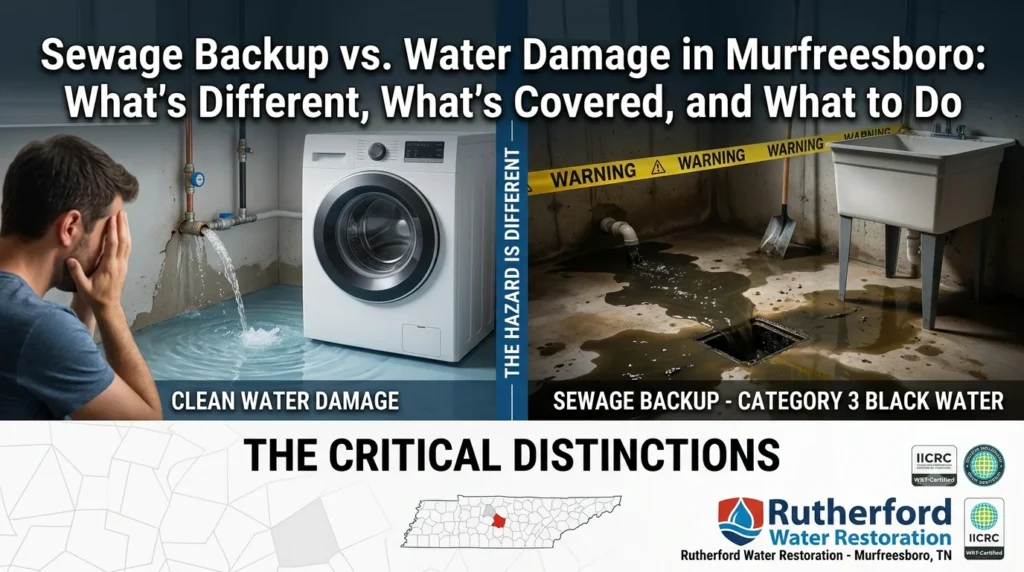
The steps after a sewage backup differ from clean water damage because the health hazard is immediate:
Step 1 — Leave the area immediately Do not remain in a room with sewage backup. Do not walk through sewage water. The pathogens in Category 3 water can be absorbed through skin abrasions, inhaled as vapor, or transmitted if you contact your face after touching contaminated surfaces. If sewage has entered a significant area of your home, leave the affected floor entirely.
Step 2 — Turn off electricity to affected areas Sewage water is electrically conductive. If sewage has reached electrical outlets, fixtures, or any part of your electrical system, turn off the circuit breakers for affected areas before anyone enters.
Step 3 — Do not attempt DIY cleanup Do not use a Shop-Vac, mop, or household cleaning products on sewage contamination. Consumer-grade disinfectants do not meet the biohazard decontamination standard required for Category 3 events. DIY attempts spread contamination, expose household members to pathogens, and may complicate insurance claims.
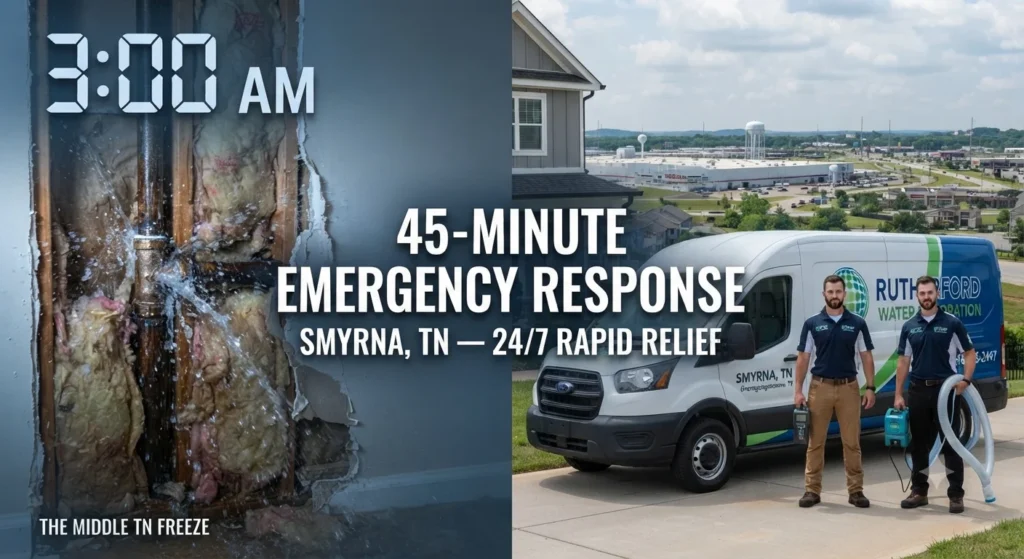
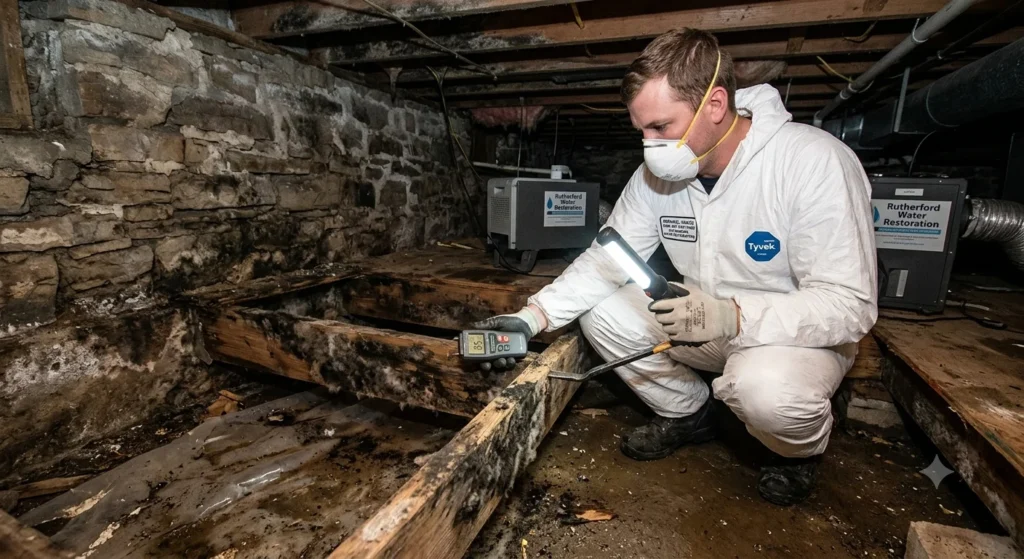
Step 4 — Call Rutherford Water Restoration at (615) 703-6099 Our technicians respond to sewage events in full personal protective equipment — Tyvek suits, respirators, and chemical-resistant gloves. We bring the appropriate antimicrobial agents, containment materials, and disposal protocols for Category 3 events. We can be at your Murfreesboro home within 45 minutes.
Step 5 — Photograph before professionals arrive If it is safe to do so without entering the affected area, photograph the backup source and extent of the sewage from a safe position. This documentation supports your insurance claim.
Step 6 — Call your insurance company Report the event to your insurance carrier the same day. If you have a sewer backup endorsement, provide the date, source, and extent of the backup. Our team provides Xactimate documentation that your adjuster will use to process the claim.
The Sewage Cleanup Process: What Rutherford Water Restoration Does
Our Category 3 sewage backup response in Murfreesboro follows a specific biohazard remediation protocol:
PPE and containment (arrival): All technicians are in full PPE. Work zones are sealed with HEPA containment barriers to prevent cross-contamination of clean areas.
Porous material removal: All porous materials in the contaminated zone — carpet, carpet padding, drywall below the sewage waterline, insulation — are removed, double-bagged in sealed plastic, and disposed of per Tennessee biohazard disposal requirements. These materials cannot be decontaminated and must be removed.
Category 3 extraction: Sewage water is extracted using industrial equipment designated for Category 3 use — not shared with clean water jobs. The extraction equipment itself is decontaminated after the job.
HEPA vacuuming of structural surfaces: All remaining surfaces — concrete slab, block foundation walls, wall studs — receive HEPA vacuuming to remove organic debris before antimicrobial treatment.
Antimicrobial application: EPA-registered antimicrobial agents designed for Category 3 events are applied to all affected structural surfaces. This is a two-step process: a disinfectant application followed by an antimicrobial treatment that creates a protective barrier on the surface.
Structural drying: After decontamination, industrial dehumidification and air movement equipment dry the structural materials. LGR dehumidifiers are positioned based on moisture mapping data.
Air quality verification: After drying is complete, air quality testing confirms that pathogen levels and mold spore counts have returned to safe levels before reconstruction begins.
Reconstruction: We restore all removed materials — drywall, flooring, baseboards — to pre-loss condition.
The Difference Between Sewage Cleanup and Mold Remediation
Sewage backup and mold remediation are related but distinct services. Here is how they intersect:
Sewage backup that is not properly remediated — or that was “cleaned up” with consumer products without adequate drying — creates near-certain mold conditions within 24–48 hours in Murfreesboro’s humidity. The bacteria in sewage provide organic nutrients for mold in addition to the moisture. A sewage backup that was poorly handled is almost always followed by mold growth.
When our team responds to a sewage event, we assess mold risk from day one. If mold is already present — which happens when a slow drain backup went unnoticed for days — the scope expands to include mold remediation alongside the Category 3 cleanup. Both are documented separately for insurance purposes.
Frequently Asked Questions
How long does sewage backup cleanup take in Murfreesboro? A single-room sewage event with confined contamination takes 3–5 days from initial cleanup through drying and reconstruction. Larger events affecting multiple rooms or requiring significant reconstruction take 1–3 weeks depending on scope.
Is sewage backup smell harmful? Yes. The gases produced by sewage — including hydrogen sulfide and methane — are hazardous at elevated concentrations. In a confined space like a basement, sewage gases can accumulate to dangerous levels. Hydrogen sulfide has a characteristic “rotten egg” odor; if the smell is strong, leave the space and ventilate before re-entering.
My Murfreesboro home had sewage backup years ago that was “cleaned up.” Should I be concerned about mold now? If the previous cleanup was performed by a non-certified company or by the homeowner without biohazard protocols, there is a meaningful risk that mold colonization has been developing inside the walls and under the flooring in the affected area. A professional mold inspection with air quality testing will determine whether remediation is needed.
Can sewage backup make my family sick? Yes. The pathogens in sewage — E. coli, Salmonella, hepatitis A, norovirus — can cause serious illness through skin contact, inhalation of aerosols, or hand-to-mouth transmission. Children, elderly individuals, and immunocompromised family members face the highest risk. Vacate the contaminated area immediately and do not return until professional remediation is complete.
Call Rutherford Water Restoration for Sewage Cleanup in Murfreesboro
Sewage backup is a biohazard emergency. Our IICRC-certified team responds with full Category 3 protocols to homes in Murfreesboro, Blackman, Smyrna, La Vergne, and all of Rutherford County.
Call (615) 703-6099 — 24/7 emergency response. We arrive in 45 minutes.