Most homeowners who have never dealt with serious water damage dramatically underestimate how fast the situation changes. What starts as a flooded bathroom floor or a burst pipe in the laundry room can escalate into a structural drying project involving every room on a floor within hours.
Understanding what is actually happening inside your walls, floors, and ceilings during those first 24 hours is not just educational — it changes the decisions you make, and those decisions directly affect the scope and cost of restoration.This guide is written for Murfreesboro and Rutherford County homeowners.water damage murfreesboro tn first 24 hours. Where national resources give general timelines, we have adjusted for the specific conditions of Middle Tennessee — including the region’s high relative humidity, construction styles common in the area, and the behavior of materials used in Murfreesboro’s housing stock.
The hour-by-hour progression of water damage inside a Murfreesboro home
Hour 0 to 1: Surface saturation begins
In the first hour after a significant water event, water is moving faster than it appears. The visible standing water you can see on a hard surface floor represents only a fraction of the moisture that has already migrated outward. Carpet absorbs water at its fiber and backing layers immediately. Hardwood flooring begins absorbing at grain boundaries before surface water is even visible. Drywall begins wicking moisture from the bottom up — the four-inch zone at the base of any drywall that has contact with standing water is typically a loss within the first 30 to 60 minutes.
What most homeowners do in this window: mop visible water, move furniture, call a plumber if the source is a pipe failure. What needs to happen in this window: stop the source, document the damage photographically, begin extraction with professional equipment if available, call a professional restoration team.
The difference between beginning professional extraction in hour one versus hour three or four is not small. Water that has been in contact with drywall for one hour can sometimes be reversed with aggressive drying. Water that has been in drywall for four hours has typically penetrated past the paper face into the gypsum core and begun migrating upward through the wall cavity.
Hours 1 to 4: Wicking, migration, and subfloor penetration
Between one and four hours after a water event, three processes are happening simultaneously that most homeowners cannot see and do not know to check for.
First, wicking. Porous building materials — drywall, wood framing, insulation, carpet backing, concrete masonry — absorb water through capillary action. This means moisture migrates upward and laterally through materials under its own tension, without gravitational assistance. A wet drywall surface will have moisture three to four inches above the visible wet line within hours of initial contact. A wet carpet will have moisture in the subfloor and subflooring adhesive that is not detectable by touch on the carpet surface.
Second, subfloor penetration. In most Murfreesboro homes built after 1985, subflooring is engineered wood (OSB or particleboard). These materials absorb water rapidly and begin to swell and delaminate. Unlike solid wood, engineered wood subflooring cannot be dried in place once it has swollen significantly — swelling exceeding about ten percent typically requires replacement. Extraction in the first four hours gives restoration technicians the best chance of rescuing subfloor materials. Delay past six to eight hours in Middle Tennessee’s humidity conditions significantly changes the calculus.
Third, cavity migration. Water that reaches a wall penetrates through the drywall into the wall cavity, where it contacts insulation and wood framing. Fiberglass batt insulation absorbs water and holds it against the framing material for extended periods. Wood framing that stays wet for more than 24 to 48 hours begins the early stages of biological degradation. This is the pathway from a water damage event to a mold problem.
| The Tennessee humidity factor At 70–80% relative humidity — typical of Murfreesboro during summer — the drying gradient between wet materials and surrounding air is lower than in drier climates. This means moisture evaporates from saturated materials more slowly even under ambient conditions. Professional drying equipment compensates by forcing air circulation and dehumidification, but the baseline evaporation rate affects how long the process takes and how aggressively equipment must be deployed. |
Hours 4 to 12: The mold window opens
By hour four, the conditions for mold growth have typically been established in a significant water event. Moisture is present in building materials. The temperature is within the range that supports biological growth — which, in a Murfreesboro home at any time of year, means almost certainly yes. The only remaining variable is time.
Mold does not appear as visible growth in the first four hours. What is happening during this window is invisible: spores that are always present in any indoor environment are landing on wet surfaces and beginning the germination process. The visible manifestation — the discoloration and surface growth that most people recognize as mold — typically appears between 24 and 72 hours after initial water contact, depending on species, temperature, and material type.
This is why the IICRC S500 Standard for Professional Water Damage Restoration, which is the industry framework that certified restoration technicians follow, establishes that mitigation of structural drying should begin as quickly as possible following a water intrusion event. The standard does not specify 24 or 48 hours as an acceptable delay — it specifies immediate action as the professional standard of care.
In Middle Tennessee’s climate, we consider 24 hours to be the outer edge of the window for preventing secondary mold damage after a significant water event. Beyond that point, remediation costs begin to increase as contaminated materials must be addressed alongside the original water damage.
Hours 12 to 24: Structural concerns and hidden damage
By the twelve-hour mark, a water event that was not addressed in the first few hours has typically expanded beyond the original impact zone. This is particularly true in Murfreesboro’s multi-story homes, where water follows gravity through floor assemblies into lower levels. A second-floor appliance leak that began as a kitchen floor situation may have water in the first-floor ceiling by hour six and visible staining through the drywall by hour twelve.
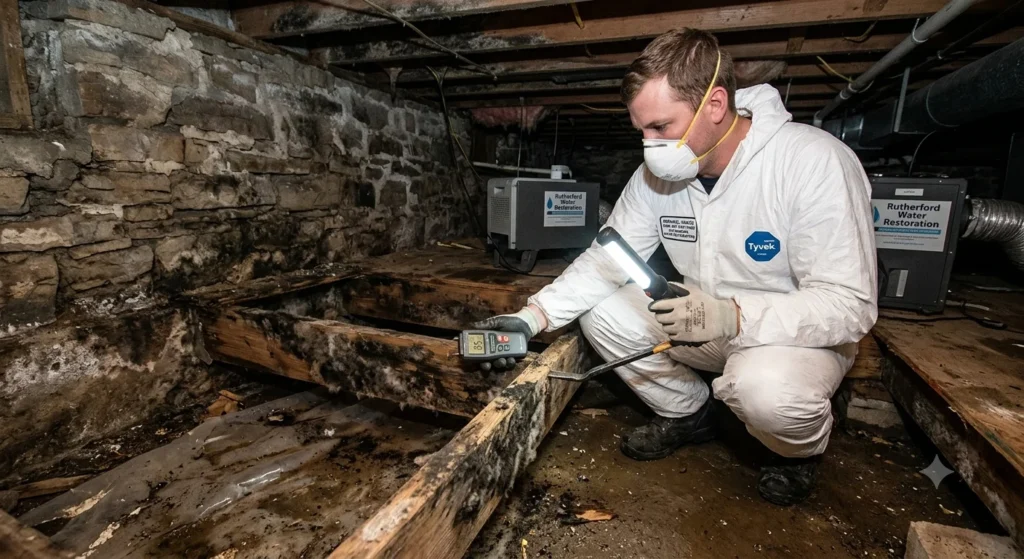
The twelve-to-twenty-four hour window is when restoration professionals using FLIR thermal imaging cameras begin to find the full extent of moisture migration. Infrared imaging reveals temperature differentials created by evaporative cooling in wet materials — walls and ceilings that look dry to the eye show clearly as wet areas on thermal images. It is common in Murfreesboro homes to find moisture in rooms adjacent to the primary impact zone that the homeowner had no idea were affected.
Structural framing that has been wet for more than 24 hours in summer conditions requires assessment. Wood framing does not immediately fail — but the biological degradation process begins, and framing that has been repeatedly wetted and dried without proper treatment is more susceptible to future problems.
What professional restoration does differently in each time window
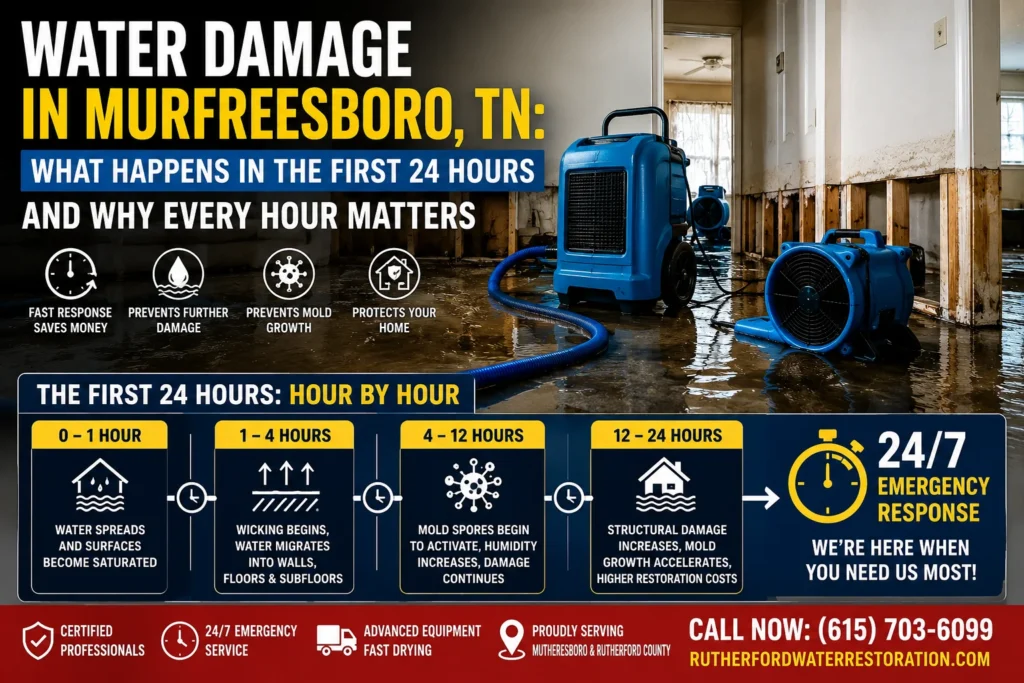
The reason certified restoration technicians follow specific protocols is that each phase of a water damage event requires different technical responses. This is not about selling more services — it is about matching the intervention to what is actually happening inside the structure.
- Immediate extraction phase: Truck-mounted or high-capacity portable extraction units remove standing and surface water at rates measured in hundreds of gallons per hour. Consumer wet vacuums remove what they can physically reach. The difference in extraction rate and depth determines how much moisture enters building materials.
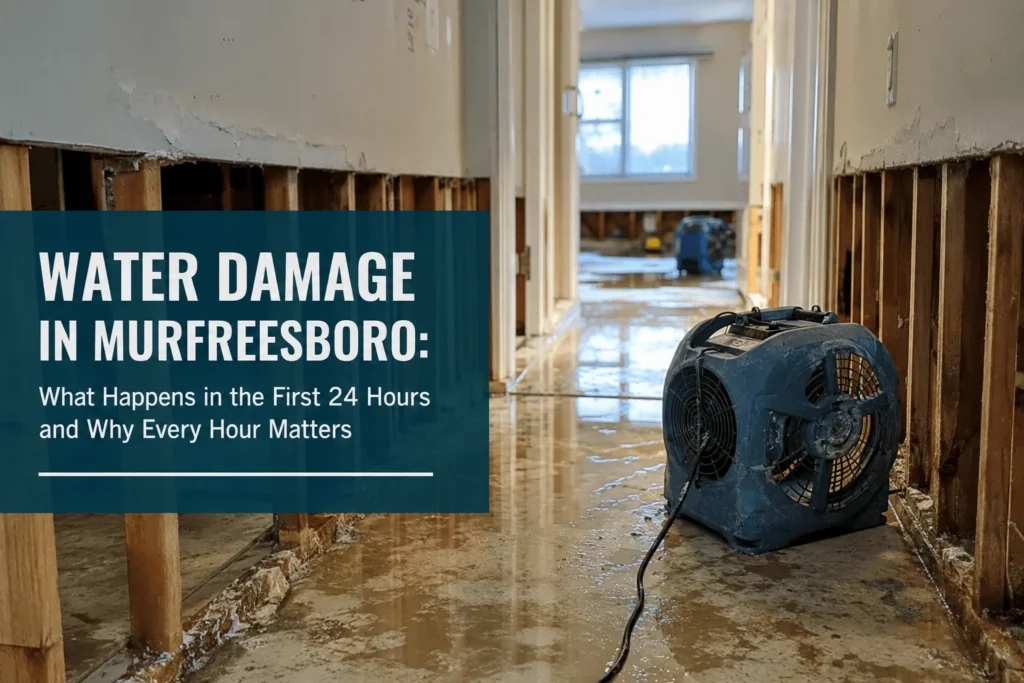
- Structural drying phase: Industrial LGR (low-grain refrigerant) dehumidifiers and high-velocity air movers create a controlled drying environment. These systems reduce the relative humidity inside the affected structure and force evaporation from wet materials at a rate that prevents biological growth while managing the rate of moisture release from structural materials. Materials dried too slowly develop mold. Materials dried too quickly can crack or warp.
- Monitoring phase: Daily moisture readings with calibrated meters confirm that materials are drying at expected rates. Drying logs documenting readings, equipment placement, and ambient conditions are essential for any claim process and demonstrate that the restoration was performed to industry standards.
- Mold prevention treatment: Antimicrobial treatments applied to at-risk surfaces after extraction and before drying equipment is removed reduce the viability of spores that have contacted wet materials. This is a preventive treatment, not a substitute for proper drying.
The most common mistakes water damage murfreesboro tn first 24 hours
In our response work across Rutherford County, we see a consistent set of decisions made in the first hours after a water event that increase total restoration costs significantly:
Using fans and dehumidifiers instead of calling for extraction
Box fans and consumer dehumidifiers cannot perform structural drying. They can reduce ambient humidity in a room, but they do not extract moisture from building materials at the rate required to prevent biological growth. Homeowners who run fans for 24 hours before calling a professional restoration team often find that the surface appearance has improved — floors feel less wet underfoot, surface moisture has evaporated — while the materials beneath have continued absorbing and the conditions for mold have been establishing.
Removing wet materials too quickly
In an effort to speed up the process, some homeowners begin tearing out wet drywall or pulling up wet carpet before a moisture assessment is completed. This can be counterproductive. Wet drywall that is removed early destroys the ability to document the extent of moisture migration for assessment purposes. In some cases, drywall that is removed in the first few hours could have been dried in place with proper equipment placement. Assessment before demolition is always the correct sequence.
Waiting to see if it dries out on its own
The most costly decision is waiting. In Murfreesboro’s climate, a flooded room that is left without professional intervention for more than 24 hours in warm months will almost certainly require mold remediation in addition to the original water damage restoration. The cost difference between a water damage job addressed in the first 12 hours versus one addressed after 48 to 72 hours is typically several thousand dollars in additional remediation scope.
Frequently asked questions — water damage timeline
How long can water damage go untreated in Murfreesboro before mold develops?
In Middle Tennessee’s climate, we consider 24 hours to be the outer edge of the safe window. Mold spores begin germination within a few hours of contact with wet materials. Visible growth typically appears within 24 to 72 hours depending on temperature and material type. Acting within the first 12 hours gives restoration professionals the best chance of preventing secondary mold damage.
Can I dry out water damage myself without calling a professional?
For minor surface spills on hard, non-porous surfaces, yes — thorough cleaning and drying is appropriate. For any event involving carpet, drywall, subfloor, or wall cavities, professional extraction and structural drying equipment is necessary to fully address the moisture in building materials. Consumer equipment operates at a small fraction of the capacity required for structural drying.
How do you find water damage behind walls in Murfreesboro homes?
IICRC-certified restoration technicians use calibrated moisture meters to measure moisture content in building materials and FLIR thermal imaging cameras to detect temperature differentials caused by evaporative cooling in wet areas. These tools identify moisture that is not visible to the eye and allow technicians to map the full extent of water migration before beginning drying.
Does water damage always require removing drywall?
Not always. Drywall that has been wet for less than 12 hours and has not developed elevated moisture readings beyond the visible wet zone can sometimes be dried in place using properly positioned air movers and dehumidifiers. Drywall that has been wet for longer periods, shows signs of swelling, or has moisture readings indicating deep penetration typically requires removal. Assessment before demolition determines the most appropriate approach.
What is the IICRC S500 standard that restoration companies reference?
The IICRC S500 is the Standard and Reference Guide for Professional Water Damage Restoration published by the Institute of Inspection, Cleaning and Restoration Certification. It defines the professional standard of care for water damage restoration, including classification systems for water types and damage categories, drying targets, documentation requirements, and safety protocols. IICRC-certified technicians are trained and tested on this standard.
Related resources on rutherfordwaterrestoration.com:
- Water extraction Murfreesboro — /services/water-extraction-murfreesboro/
- Structural drying and dehumidification — /services/structural-drying-dehumidification/
- Mold remediation Murfreesboro TN — /services/mold-remediation-murfreesboro-tn/
- Emergency water damage response — /services/emergency-water-damage-murfreesboro/
| Dealing with water damage in Murfreesboro or Rutherford County? Call Rutherford Water Restoration 24/7: (615) 703-6099 | rutherfordwaterrestoration.com |