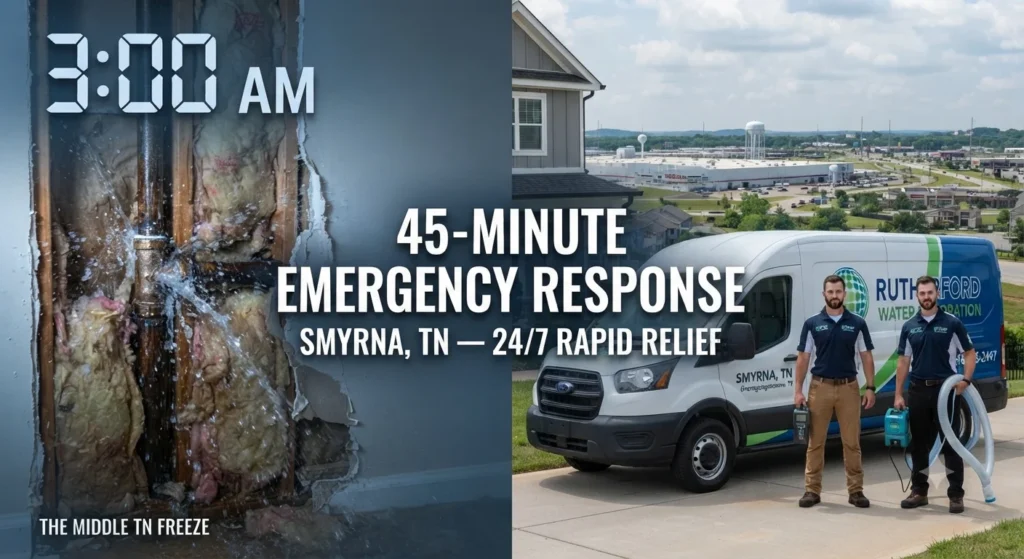
Water damage in Murfreesboro, Tn moves fast — and so does mold. Whether your water heater burst in Blackman, a pipe froze on a January night near MTSU, or the Stones River watershed sent runoff through your crawl space after a spring storm, the actions you take in the first 24 hours will determine whether you face a $3,000 drying job or a $30,000 mold remediation. This guide walks you through exactly what to do, step by step, so you protect your family, preserve your property, and build an airtight insurance claim from the very first minute.
Why the First 24 Hours Are Critical in Middle Tennessee
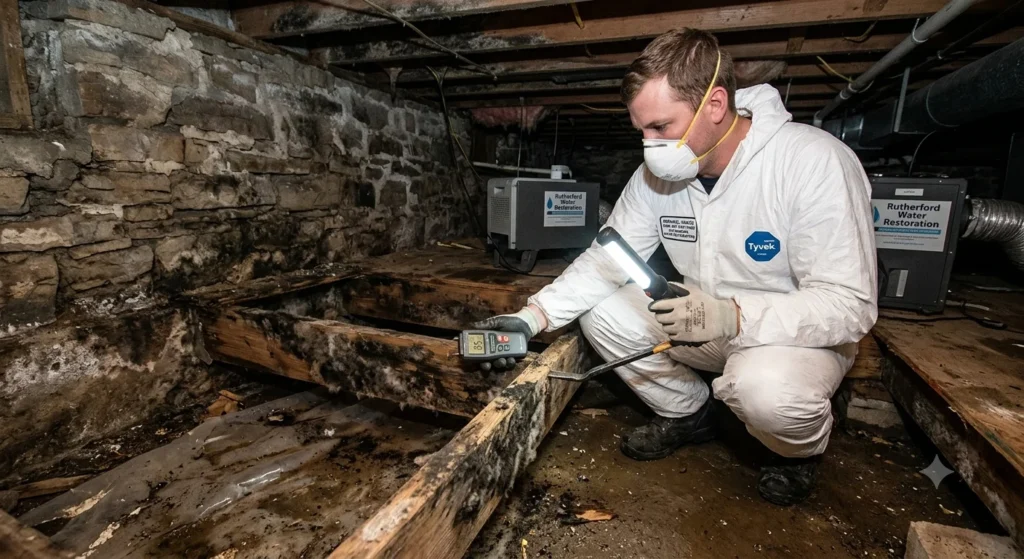
Most national water damage guides cite a “48-hour mold window.” That standard does not apply to Murfreesboro. Rutherford County’s summer humidity consistently runs between 70% and 80%, and the Stones River watershed contributes groundwater pressure that keeps subfloor materials damp long after visible water is removed. In these conditions, mold colonies can begin forming within 24 hours of a water intrusion event — sometimes sooner in poorly ventilated crawl spaces and basements.
The IICRC S500 Standard for Professional Water Damage Restoration — the industry benchmark our team follows — classifies water damage by how quickly structural materials absorb moisture. In Middle Tennessee’s climate, drywall begins absorbing water within minutes of contact. Subfloor wood can reach saturation within two to four hours.
Once The IICRC S500 Standard for Professional Water Damage Restoration — the industry benchmark our team follows — classifies water damage by how quickly structural materials absorb moisture. In Middle Tennessee’s climate, drywall begins absorbing water within minutes of contact. Subfloor wood can reach saturation within two to four hours. Once saturation occurs, drying time multiplies, restoration costs increase, and mold risk rises sharply. Every hour you wait is a decision that will show up on your final invoice.
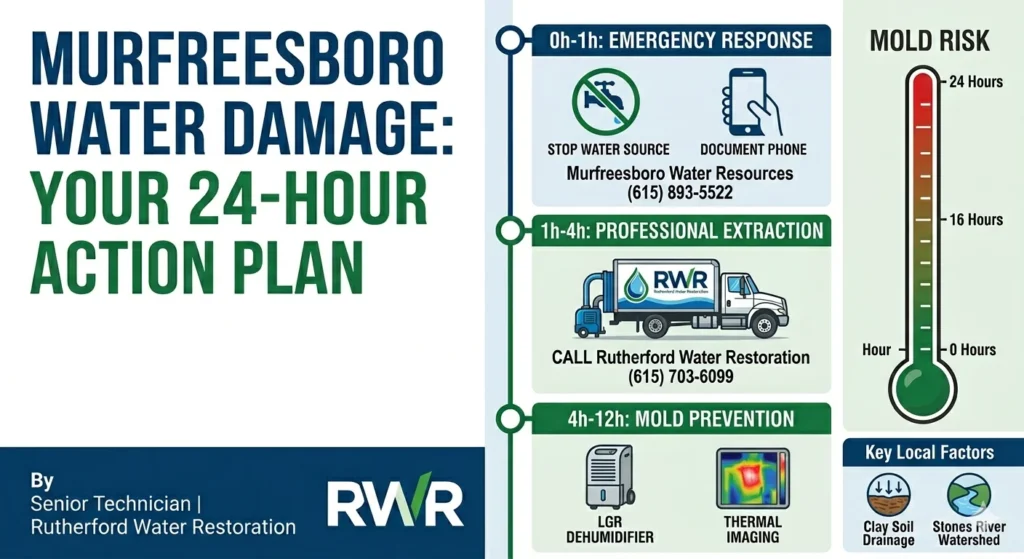
Step 1: Stop the Water damage in Murfreesboro Tn Source (Minutes 1–15)
Before you call anyone, stop the water if it is physically safe to do so. This single action limits the spread more than anything else you will do.
For plumbing failures: Locate your main water shutoff valve. In most Murfreesboro homes, this is near the water meter at the street or in the garage. Turn it clockwise until it stops. If you cannot find it, call Murfreesboro Water Resources at (615) 703 6099 — they operate a 24-hour emergency line.
For appliance failures (washing machine, dishwasher, water heater): Pull the appliance away from the wall and turn off the supply valve on the hose connection behind the unit. Most supply valves are quarter-turn ball valves that stop flow immediately.
For roof leaks or storm entry: You cannot stop rain, but you can limit interior spread by placing buckets and moving furniture and electronics off the floor immediately. If ceiling drywall is bulging from trapped water, carefully pierce it with a screwdriver to release water in a controlled stream rather than allowing it to collapse.
For Stones River flooding or sinkhole runoff: Do not enter standing water if you are unsure of the depth or electrical hazard. Turn off electricity at the breaker panel before entering any flooded area.
Step 2: Document Everything Before You Touch It (Minutes 15–30)
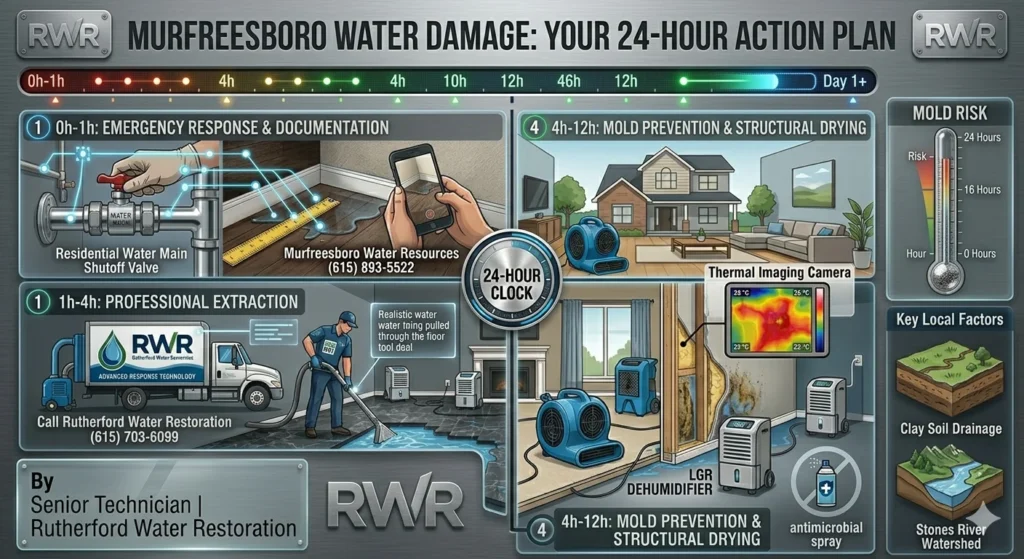
Your insurance claim lives or dies on documentation, and most water damage in Murfreesboro tn homeowners weaken their own claims by cleaning up before photographing. Your smartphone is your most important tool in the first 30 minutes.
What to photograph and video:
- Every room with any visible water, staining, or damage
- The water source (the burst pipe, the failed appliance, the roof penetration)
- All standing water, including measuring the depth with a ruler if possible
- Flooring, baseboards, drywall, and any furniture affected
- Your water meter reading (photographs the meter reading to establish the volume of water lost)
- The exterior of your home if storm damage is involved
Critical rule: Do not move damaged items before photographing them. Insurance adjusters are trained to look for evidence that content was moved before documentation — this can trigger claim disputes. Photograph everything in its damaged position first, then move it.
Take at least one video walkthrough of your entire home narrating what you see. This video timestamp is often the strongest single piece of evidence in an insurance dispute.
Step 3: Call Your Insurance Company (Minutes 30–45)
Contact your homeowner’s insurance provider as soon as you have documented the damage. Most Tennessee homeowners insurance policies cover sudden and accidental water damage from plumbing failures and appliance failures. Flood damage from external water sources (rising rivers, surface runoff, Stones River watershed events) typically requires a separate NFIP flood insurance policy.
When you call your insurer, have ready:
- Your policy number
- The approximate time the damage occurred
- A description of the source (burst pipe, appliance failure, storm, flooding)
- Your photo and video documentation ready to upload
Ask your adjuster specifically: “Does my policy cover water extraction, structural drying, mold remediation, and contents replacement?” Get this answer in writing before authorizing any work.
Important: You do not need to wait for an adjuster to arrive before calling a restoration company. In fact, waiting increases your damage and can complicate your claim. A professional restoration company — such as Rutherford Water Restoration — provides documentation that supports your claim, not undermines it.
Step 4: Call a Professional Restoration Company (Minutes 45–60)
This is not the step where you rent a wet-vac from Home Depot. Consumer-grade equipment does not remove moisture from inside wall cavities, from under subfloor materials, or from inside concrete block — all common structural assemblies in Murfreesboro homes. Running household fans in a saturated room actually spreads mold spores without drying the structure.
A professional water damage restoration company serving Murfreesboro brings:
Truck-mounted extraction units capable of removing hundreds of gallons per hour from carpet, hardwood, and tile simultaneously. These units generate suction that no portable wet-vac can match.
LGR (low-grain refrigerant) dehumidifiers that pull moisture from the air and from within structural materials simultaneously. LGR technology is specifically designed for the high-humidity conditions common in Middle Tennessee summers.
FLIR thermal imaging cameras that locate moisture trapped behind drywall, under flooring, and inside wall cavities that show no visible surface signs. This technology is the difference between a complete dry-out and a hidden mold problem discovered six months later during a home sale inspection.
Calibrated moisture meters that track drying progress to IICRC S500 standard targets — objective data your insurance adjuster will accept as proof of a completed, professional restoration.
Our team at Rutherford Water Restoration dispatches from Rutherford County and arrives at homes in Murfreesboro, Smyrna, La Vergne, and Blackman within 45 minutes of your call, 24 hours a day. A real local technician answers every call — not a national call center.
Step 5: Protect Your Health and Contents (Hours 1–4)
While waiting for restoration professionals, take these protective steps:
Electricity: If water has reached any electrical outlets, panels, or appliances, turn off the electricity to affected areas at the breaker panel. Do not re-enter water-affected areas where electrical hazards are possible.
Move porous contents off wet floors: Books, documents, fabric items, wood furniture, and electronics absorb water rapidly. Move everything you can reach to a dry area. Place aluminum foil under the legs of furniture sitting on wet carpet to prevent staining.
Do not use a vacuum cleaner or standard fans: Vacuums are not designed for liquid use and create electrical hazards. Fans in a flooded room spread airborne mold spores without drying structural materials.
Prescription medications and documents: Move these to a dry location immediately. Water-damaged prescription medications may be unsafe to take and will need replacement.
Pets: Keep pets out of water-damaged areas. Standing water from sewage backups or storm flooding may carry pathogens dangerous to animals and children.
Step 6: Prevent Mold — Middle Tennessee’s Fastest Clock
In Murfreesboro’s climate, the mold prevention clock starts the moment the water intrusion begins. Here is the realistic timeline you are working against:
| Hour | What is happening inside your walls |
| 0–1 | Drywall paper facing begins absorbing moisture |
| 1–4 | Insulation becomes saturated; wood framing begins absorption |
| 4–12 | Subfloor plywood reaches saturation in high-humidity conditions |
| 12–24 | Mold spore germination begins on wet organic materials |
| 24–48 | Visible mold colonies can form in Middle Tennessee’s humidity |
| 48–72 | Structural drying becomes significantly more complex and expensive |
This timeline is why Rutherford County homeowners cannot treat water damage as a “deal with it Monday” situation that occurs on a Friday night. Our 24/7 emergency response exists precisely because every hour of delay in this climate compounds the restoration scope.
What NOT to Do After Water Damage in Murfreesboro tn
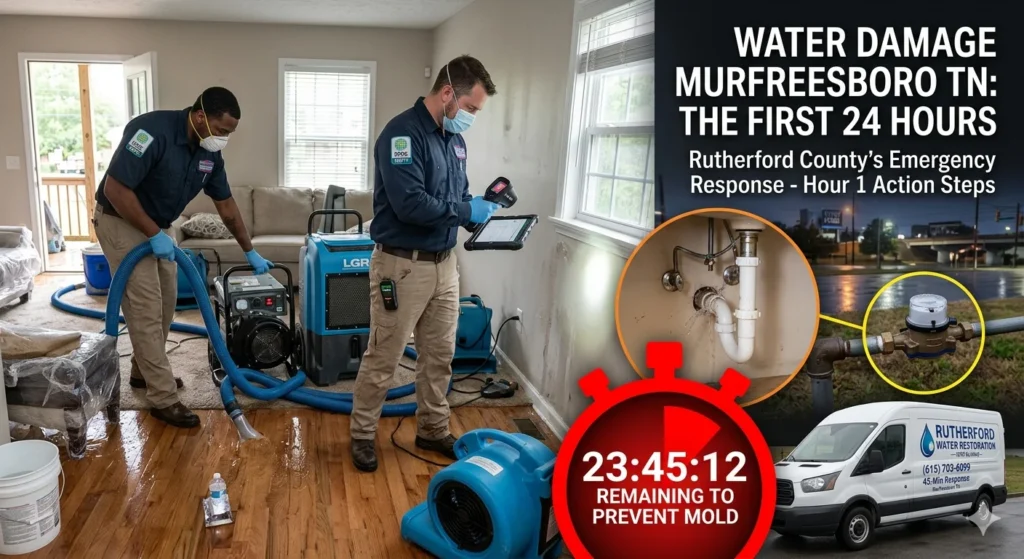
Equally important as the correct steps are the actions that homeowners take which worsen the situation:
Do not use a ShopVac as your primary extraction tool. A standard shop vacuum removes visible standing water but leaves moisture in the structural materials where mold actually grows. SERVPRO of Rutherford County notes this exact problem — household suction equipment cannot identify the water migration line inside materials.
Do not run your HVAC system. Your air conditioning and heating system circulates air throughout your home. If mold spores are present — or beginning to form — your HVAC system will distribute them to rooms that were previously unaffected. Turn the system off and leave it off until a professional has assessed the damage.
Do not use bleach on mold. Bleach kills surface mold on non-porous surfaces but does not penetrate porous materials like drywall or wood where mold roots deeply. It also leaves behind moisture that can encourage regrowth. IICRC-certified remediation uses antimicrobial treatments specifically designed for porous building materials.
Do not throw away damaged materials before your insurance adjuster documents them. Keep all damaged materials — carpet, padding, drywall pieces, furniture — until your adjuster has documented them. Disposal before documentation is one of the most common reasons claims are reduced or denied.
Rutherford County-Specific Water Damage Risks
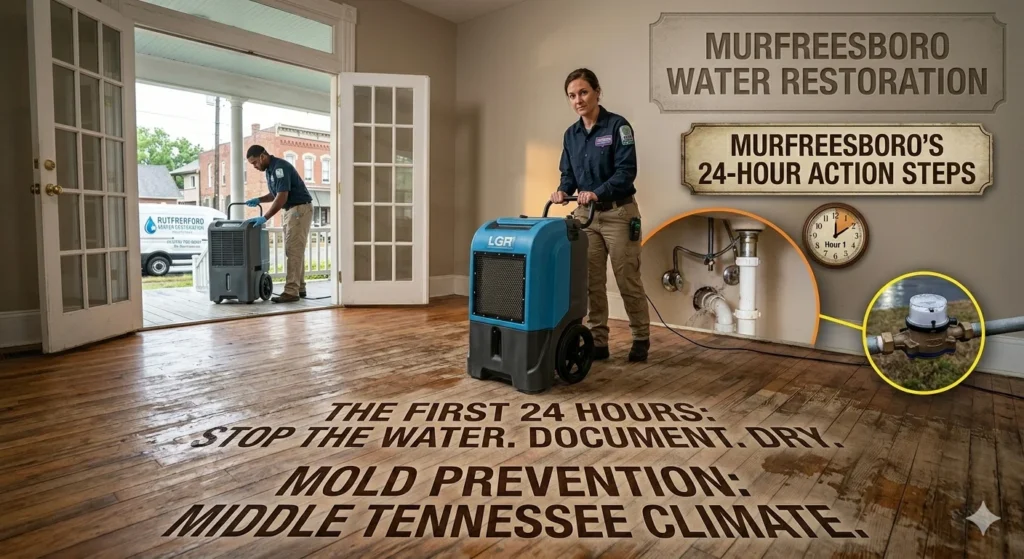
Murfreesboro and the surrounding Rutherford County communities face water damage risks that are specific to this geography:
Stones River watershed flooding: Murfreesboro sits within the Stones River Watershed, which covers 556 square miles of Rutherford County. The most critical flooding period runs from December through April. Homes near the West Fork Stones River, Lytle Creek, and Todds Lake sinkhole area face elevated flood risk during high-intensity storm events.
Clay soil drainage: Much of Rutherford County sits on heavy clay soils that shed rather than absorb water during heavy rainfall. This creates rapid surface runoff that enters foundations, crawl spaces, and basement walls even when homes are not near any waterway.
January and February freeze events: Middle Tennessee’s mild winters turn dangerous during polar vortex events. Pipes in exterior walls, garage plumbing, and crawl space supply lines in Murfreesboro homes are vulnerable during hard freezes. Burst pipe events spike dramatically during these periods.
Summer humidity and appliance failures: At 70–80% relative humidity, any appliance failure in summer months — washing machine, dishwasher, water heater — creates a perfect mold environment within hours if not professionally dried.
What Rutherford Water Restoration Does in the First 24 Hours
When you call us at (615) 703-6099, here is exactly what happens:
Call answered (minute 0): A live Rutherford County technician — not a call center — answers and asks you the key triage questions: Is the water source stopped? Is electricity safe? Is the water clean, gray, or sewage?
Dispatch (minutes 0–5): Based on your location — whether you are in Murfreesboro (37127–37133), Smyrna, La Vergne, or Blackman — we dispatch the nearest available crew with appropriate equipment loaded.
On-site assessment (minutes 45–60): Our technician performs a complete moisture assessment using thermal imaging and calibrated meters, documents all affected areas with photographs, and establishes a drying plan.
Extraction begins (hour 1): Truck-mounted extraction units begin removing standing and surface water immediately. This is the first critical step before any drying equipment is deployed.
Structural drying setup (hours 2–4): LGR dehumidifiers and industrial air movers are positioned based on the moisture mapping data. The number and placement of units follow IICRC S500 protocols for your specific floor plan and material assembly.
Insurance documentation begins (day 1): We photograph, measure, and record all affected areas using Xactimate, the industry-standard insurance documentation software. Your adjuster receives documentation in the format they expect, reducing back-and-forth and speeding approval.
Frequently Asked Questions
How quickly does mold grow after water damage in Murfreesboro?
In Rutherford County’s climate — with summer humidity averaging 70–80% — mold germination can begin within 24 hours of a water intrusion event. This is faster than the national 48-hour guideline. Professional drying must begin the same day.
Does homeowners insurance cover water damage in Tennessee?
Standard homeowners insurance covers sudden and accidental water damage from internal sources like burst pipes and appliance failures. Flood damage from external sources requires separate NFIP flood insurance. Our team works with both types of policies and handles documentation for both.
Can I stay in my home after water damage?
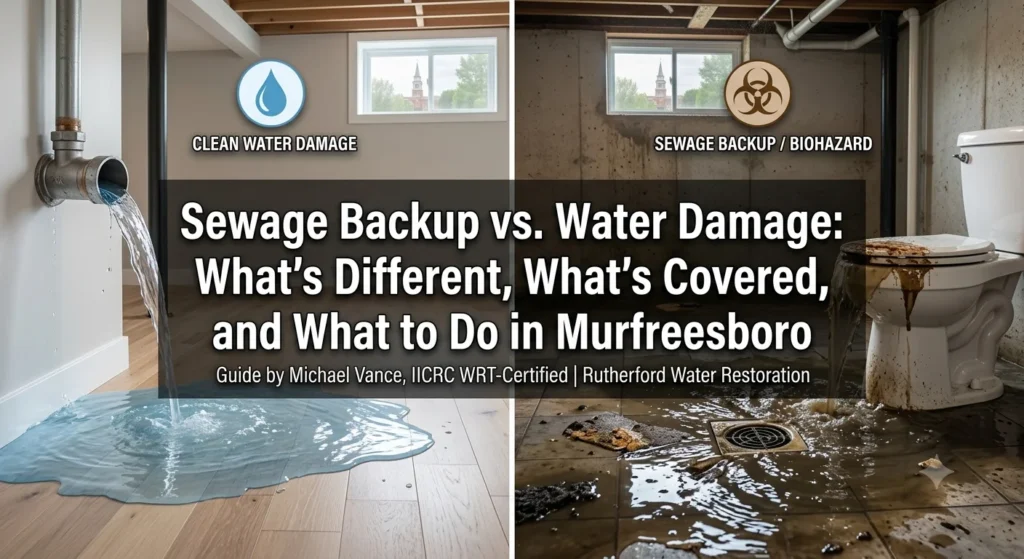
It depends on the extent and source of the damage. Clean water damage from a pipe break in one room is generally safe to occupy the rest of the home while drying occurs. Sewage backup, Category 3 (black water) flooding, or whole-home events typically require temporary relocation. We assess this on arrival.
What does water damage restoration cost in Murfreesboro?
Costs vary significantly by scope. A single-room extraction and drying can run $1,500–$3,500. Multi-room events with mold remediation and reconstruction can reach $15,000–$40,000 or more. Your insurance policy determines how much of this you pay out of pocket. We provide Xactimate documentation that maximizes legitimate claim recovery.
Call Rutherford Water Restoration Now
If you are dealing with water damage in Murfreesboro right now, do not wait. Every hour in Middle Tennessee’s humidity costs you money and health risk.
Call (615) 703-6099 — we answer 24 hours a day, 7 days a week.
Our IICRC-certified crew will be at your Murfreesboro, Smyrna, La Vergne, or Blackman property within 45 minutes. We stop the damage before mold starts.
Rutherford Water Restoration is an IICRC-certified firm serving all of Rutherford County, Tennessee. Our technicians are WRT (Water Restoration Technician) certified and follow IICRC S500 standards on every job.